

Photoelectric Sensor Market Analysis Report Providing Insights on Growth, Segmentation, and Key Competitors
Photoelectric Sensor Market Report
Photoelectric Sensor Market Trends

Photoelectric Sensor Market Demand
The Business Research Company’s Photoelectric Sensor Global Market Report 2026 – Market Size, Trends, And Forecast 2026-2035
LONDON, GREATER LONDON, UNITED KINGDOM, October 14, 2026 /EINPresswire.com/ -- The photoelectric sensor market is on track for significant growth as industries increasingly rely on advanced sensing technologies to boost automation and efficiency. This sector is a crucial part of the broader Electrical and Electronics Components industry, with its expanding applications promising substantial market value and innovation opportunities in the coming years.
Market Size and Expected Expansion in the Photoelectric Sensor Market
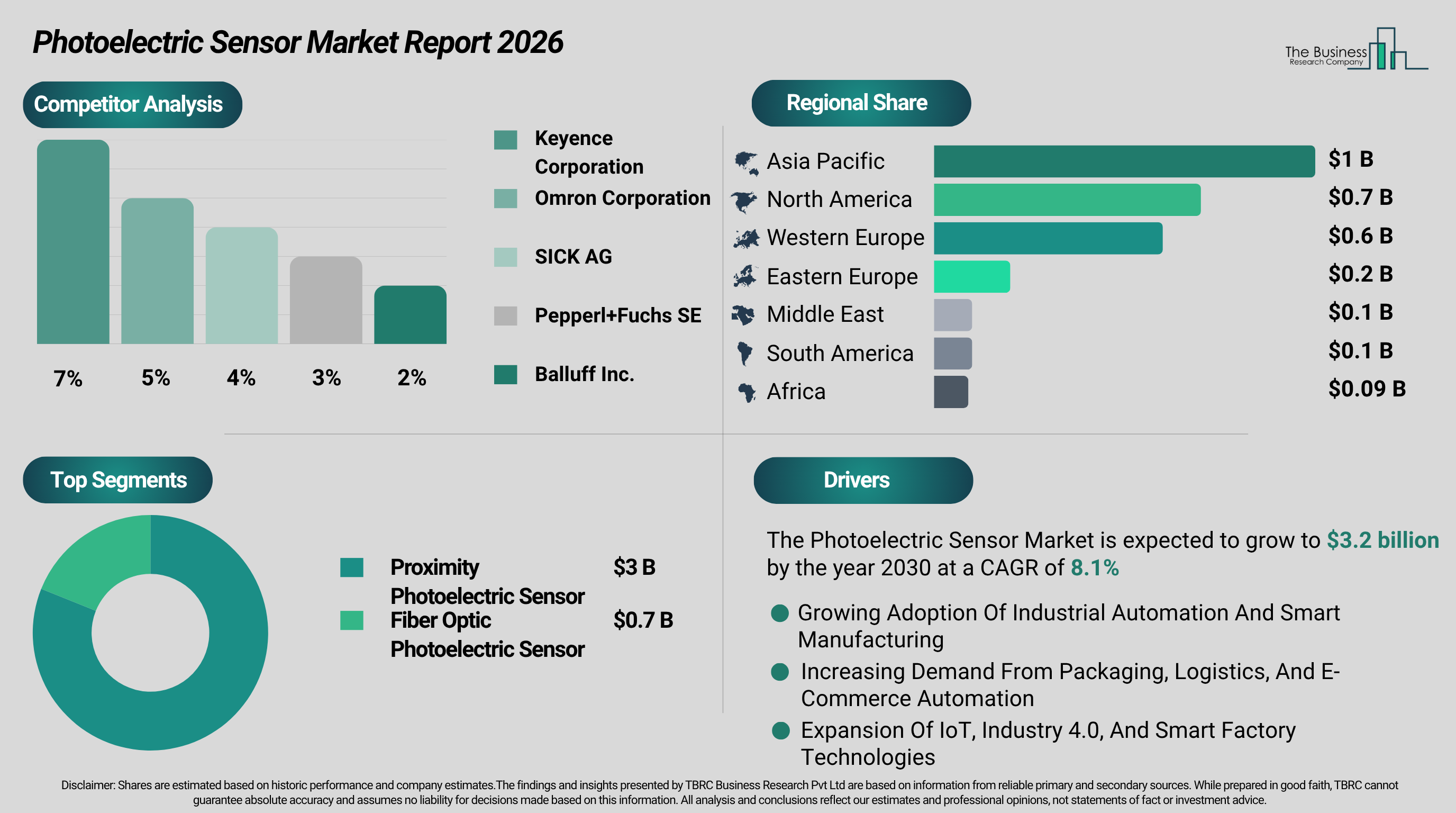
The photoelectric sensor market is forecasted to surpass $3 billion by 2030. It forms about 3% of the Electrical And Electronics Components market, which itself is anticipated to reach nearly $121 billion by the same year. Zooming out further, the entire Electrical And Electronics industry is projected to hit $5,579 billion by 2030, with photoelectric sensors accounting for just under 0.1% of this vast total.
Request A Free Sample Of The Photoelectric Sensor Market Report
https://thebusinessresearchcompany.com/sample_request?id=44206338&type=smp&name=Photoelectric%20Sensor%20Market%20Report%202026&utm_source=EINPresswire&utm_medium=Paid&utm_campaign=Oct_PR
Steady Growth Predicted for Photoelectric Sensor Market
Looking ahead to 2030, the photoelectric sensor market is expected to grow steadily at a compound annual growth rate (CAGR) of 8%, driven by rising demand for precision sensing in automated environments and smart manufacturing.
Regional Market Leadership and Growth Trends in Photoelectric Sensors
The Asia-Pacific region is set to be the dominant player in the photoelectric sensor market by 2030, valued at $1.4 billion, up from $0.9 billion in 2025. This growth, at a CAGR of 9%, is primarily fueled by the surge in factory automation, smart production lines requiring non-contact sensing, and increased investments in industrial robots and automation equipment.
Access The Detailed Photoelectric Sensor Market Report Here
https://thebusinessresearchcompany.com/report/photoelectric-sensor-global-market-report?utm_source=EINPresswire&utm_medium=Paid&utm_campaign=Oct_PR
China’s Emerging Dominance in the Photoelectric Sensor Industry
China is expected to lead the market nationally with a valuation of $0.7 billion in 2030, growing from $0.5 billion in 2025 at an annual growth rate of 9%. Growth here is supported by expanding domestic production of automation tools, intelligent manufacturing advancements in crucial sectors, investments in electronics and semiconductor facilities, and the use of sensor-based monitoring systems to enhance productivity and equipment performance.
Key Segments Driving the Photoelectric Sensor Market
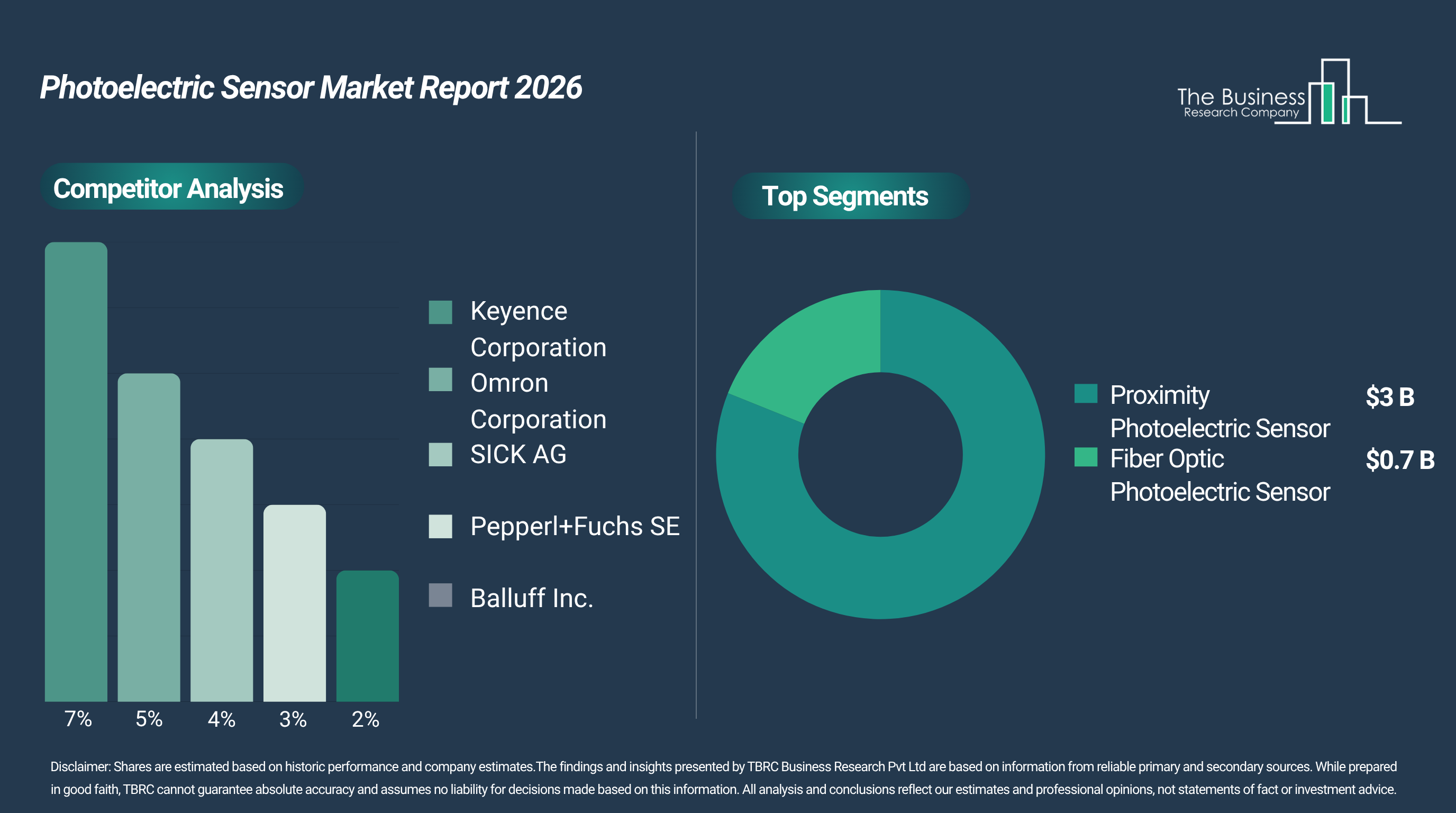
When broken down by type, the market divides into proximity photoelectric sensors and fiber optic photoelectric sensors. Proximity photoelectric sensors will dominate in 2030, making up 78% of the market or approximately $3 billion. This segment benefits from demand for rapid object detection in automated plants, integration with conveyor systems, preference for compact and accurate sensors in tight spaces, and rugged designs suited for industrial applications.
Additional Ways to Categorize the Photoelectric Sensor Market
The market also segments by technology into retro-reflective, through-beam, diffused, and other sensor types. Range classifications include sensors detecting up to 100 mm, between 100 to 1,000 mm, 1,000 to 10,000 mm, and beyond 10,000 mm. Applications cover a broad spectrum such as consumer electronics, industrial manufacturing, automotive and transport, building automation, food and beverage, pharmaceutical and medical sectors, packaging, and more.
Key Factors Propelling Photoelectric Sensor Market Growth to 2030
Three main drivers are fueling this market’s expansion: adoption of industrial automation and smart manufacturing techniques, growth in automation for packaging, logistics, and e-commerce, and the spread of IoT, Industry 4.0, and smart factory technologies.
Industrial Automation and Smart Manufacturing as Growth Engines
Manufacturers increasingly use non-contact sensing technologies for tasks like object detection, positioning, inspection, and machine safety, raising efficiency and precision. The rapid deployment of robotics, digital factories, and intelligent systems in sectors such as automotive, electronics, food and beverage, pharmaceuticals, and packaging is expected to add around 2.3% annual growth to the market.
Automation in Packaging, Logistics, and E-Commerce Boosting Demand
The reliance on photoelectric sensors in automated warehouses, fulfillment centers, and distribution hubs is growing rapidly. These sensors play a vital role in package detection, conveyor monitoring, sorting, pallet handling, and inventory management. This driver is estimated to contribute approximately 2.1% growth annually, supporting high-volume operational efficiency.
Impact of IoT, Industry 4.0, and Smart Factory Innovations
Connected sensors equipped with digital communication capabilities enable real-time monitoring, predictive maintenance, diagnostics, and optimized production processes in advanced manufacturing facilities. The integration of cloud computing, AI, and industrial networking is expected to steadily increase demand for intelligent sensors, contributing an estimated 1.8% growth each year.
Promising Growth Opportunities in Proximity and Fiber Optic Sensors
The proximity and fiber optic photoelectric sensor segments offer significant potential, projected to collectively add over $1.2 billion in value by 2030. Proximity sensors alone are expected to grow by $1 billion, while fiber optic sensors will add $0.2 billion from 2025 to 2030. Drivers include demand for compact, high-precision sensing, intelligent sensors in automated systems, high-speed detection for complex applications, and improved digital connectivity.
Competitive Landscape of the Photoelectric Sensor Market
The photoelectric sensor space is shaped by a mix of global industrial automation providers and specialized sensor manufacturers. These companies focus on delivering advanced optical sensing, high-precision detection, smart sensor integration, and enhanced automation connectivity, aiming to increase their footprint across multiple industrial sectors. Emphasizing manufacturing efficiency, real-time monitoring, accuracy, and seamless integration with industrial IoT and digital control systems is central to their competitive approach.
Market Share Leaders in Photoelectric Sensors
In 2025, Keyence Corporation was the top seller globally, holding a 7% market share. Their sensing systems division specializes in photoelectric sensors, laser sensors, vision-based detection, and measurement solutions tailored for industrial automation, precision manufacturing, quality control, and smart factory applications.
Moderate Fragmentation and Competitive Dynamics in the Market
The market is moderately fragmented, with the top 10 companies accounting for about 27% of total revenues in 2025. Barriers to entry include the need for advanced sensing capabilities, precise detection, integration with automation, innovation, and consistent performance in industries like manufacturing, automotive, electronics, and process automation. Leading suppliers maintain their positions through diverse sensor portfolios, solid automation partnerships, global distribution networks, and ongoing technological advancements. As demand for smart manufacturing and connected equipment grows, collaboration, new product launches, and geographic expansion are expected to intensify competition.
Prominent Industry Players in the Photoelectric Sensor Sector
Key players in this market include Keyence Corporation, Omron Corporation, SICK AG, Pepperl+Fuchs SE, Balluff Inc., Banner Engineering Corp., Leuze electronic GmbH + Co. KG, ifm electronic GmbH, Baumer Group, Hans Turck GmbH & Co. KG (Turck), Autonics Corporation, Schneider Electric SE, Eaton Corporation plc, Rockwell Automation Inc., Contrinex AG, Optex Group Co., Ltd., Panasonic Holdings Corporation, Hamamatsu Photonics K.K., Laser Components GmbH, di-soric GmbH & Co. KG, and Telco Sensors A/S.
Recent Innovations Highlighted in the Photoelectric Sensor Market
The market is witnessing the introduction of compact, configurable photoelectric sensors that enhance detection accuracy, increase automation efficiency, and allow for flexible integration into manufacturing setups. For example, in December 2025, Balluff Inc. launched the BOS R072K optical sensor entry line. This new series features multiple sensing principles, diverse connection options, a compact IP67-rated housing, and 360-degree LED status indicators, improving reliability and ease of installation for industrial automation, robotics, and material handling.
Strategies Driving Competitive Advantage in the Photoelectric Sensor Market
Companies are focusing on advancing sensor technologies to boost accuracy and reliability, designing new sensors to enhance performance and adaptability, expanding automation infrastructures to increase demand, and integrating artificial intelligence to make sensors smarter and more efficient.
The Photoelectric Sensor Market’s Supply Chain and End Users
Raw materials for photoelectric sensors come from suppliers such as ams-OSRAM AG, Vishay Intertechnology, Broadcom Inc., Texas Instruments, STMicroelectronics, Infineon Technologies, ON Semiconductor, Renesas Electronics, Analog Devices, ROHM, Murata Manufacturing, TDK Corporation, Kyocera, Hamamatsu Photonics, Sony Semiconductor Solutions, Panasonic Industry, Nichia Corporation, Everlight Electronics, Lumentum Holdings, II-VI Incorporated, TE Connectivity, Molex, Corning Incorporated, Schott AG, and Heraeus Holding.
Wholesalers and distributors include companies like Digi-Key Electronics, Mouser Electronics, Arrow Electronics, Avnet, TTI, RS Group, Newark Electronics, Allied Electronics & Automation, element14, Rutronik Elektronische Bauelemente, Farnell Global, Conrad Electronic, Distrelec Group, Master Electronics, Richardson Electronics, Sager Electronics, PEI-Genesis, Heilind Electronics, Electrocomponents, Macnica, WPG Holdings, Marubeni Information Systems, Fusion Worldwide, and Smith & Associates.
End users span a wide range of industry leaders such as Keyence Corporation, Omron Corporation, SICK AG, Pepperl+Fuchs SE, Rockwell Automation, Schneider Electric, Siemens AG, Honeywell International, Banner Engineering, ifm electronic, Balluff, Leuze electronic, Turck, Baumer Group, Cognex, Mitsubishi Electric, Bosch Rexroth, FANUC, Yaskawa Electric, Datalogic, Zebra Technologies, Autonics, Wenglor sensoric, and Sick Vertriebs GmbH.
Expanded capabilities in our 2026 market reports:
• Market attractiveness scoring and analysis
• Total addressable market (TAM) analysis
• Company scoring matrix graphics and tables
• Excel-based forecasting dashboards
• Market hotspots infographics
• Key technologies and future trend analysis
• Updated graphics and tables
Learn More About The Business Research Company
The Business Research Company (www.thebusinessresearchcompany.com) is a leading market intelligence firm renowned for its expertise in company, market, and consumer research. We have published over 30,000+ reports across 27 industries and 60+ geographies. Our research is powered by 1,500,000 datasets, extensive secondary research, and exclusive insights from interviews with industry leaders.
We provide continuous and custom research services, offering a range of specialized packages tailored to your needs, including Market Entry Research Package, Competitor Tracking Package, Supplier & Distributor Package and much more.
Disclaimer: Please note that the findings, conclusions and recommendations that TBRC Business Research Pvt Ltd delivers are based on information gathered in good faith from both primary and secondary sources, whose accuracy we are not always in a position to guarantee. As such TBRC Business Research Pvt Ltd can accept no liability whatever for actions taken based on any information that may subsequently prove to be incorrect. Analysis and findings included in TBRC reports and presentations are our estimates, opinions and are not intended as statements of fact or investment guidance.
Contact Us:
The Business Research Company
Americas +1 310-496-7795
Europe +44 7882 955267
Asia & Others +44 7882 955267 & +91 8897263534
Email: marketing@tbrc.info
Follow Us On:
LinkedIn: https://in.linkedin.com/company/the-business-research-company
Oliver Guirdham
The Business Research Company
+44 7882 955267
info@tbrc.info
Visit us on social media:
LinkedIn
Facebook
X
Legal Disclaimer:
EIN Presswire provides this news content "as is" without warranty of any kind. We do not accept any responsibility or liability for the accuracy, content, images, videos, licenses, completeness, legality, or reliability of the information contained in this article. If you have any complaints or copyright issues related to this article, kindly contact the author above.
